
What is Little Red Book Xiaohongshu? Why Brands Need it?
RedNote (Xiaohongshu, often shortened to RED) is one of China’s most influential social media apps, a platform where users share experiences, write reviews, search for recommendations, and increasingly buy products directly.
It combines beautiful visual content with detailed user opinions, and it has become a trusted reference point for millions of young consumers making everyday decisions. More than just a photo-sharing app, RED functions as a mix of Instagram’s aesthetics, Pinterest’s saving behavior, and the trust people associate with product reviews, all within one ecosystem. We covered this concept with our previous article China Social Media Trends 2026: The Super-Apps Revolution.
The Story of RED: From PDF to Platform
Before we get into details, RED’s origin stories is definitely worth mentioning! It didn’t begin as an app built for attention. Actually, It began as something really simple: a PDF shopping guide. In 2013, founders Miranda Qu and Charlwin Mao noticed a gap Chinese travelers kept running into, people heading to Hong Kong wanted reliable, peer-to-peer advice on what to buy, what was worth the money, and what to skip.
That “guide” mindset turned into something far more powerful once users started sharing their own real discoveries. One helpful recommendation became ten. Ten became a culture. And that culture became a platform. With this in mind, it’s definitely easier to understand how the hype around RED developed and why until now, users see it as a trustworthy and authentic platform.
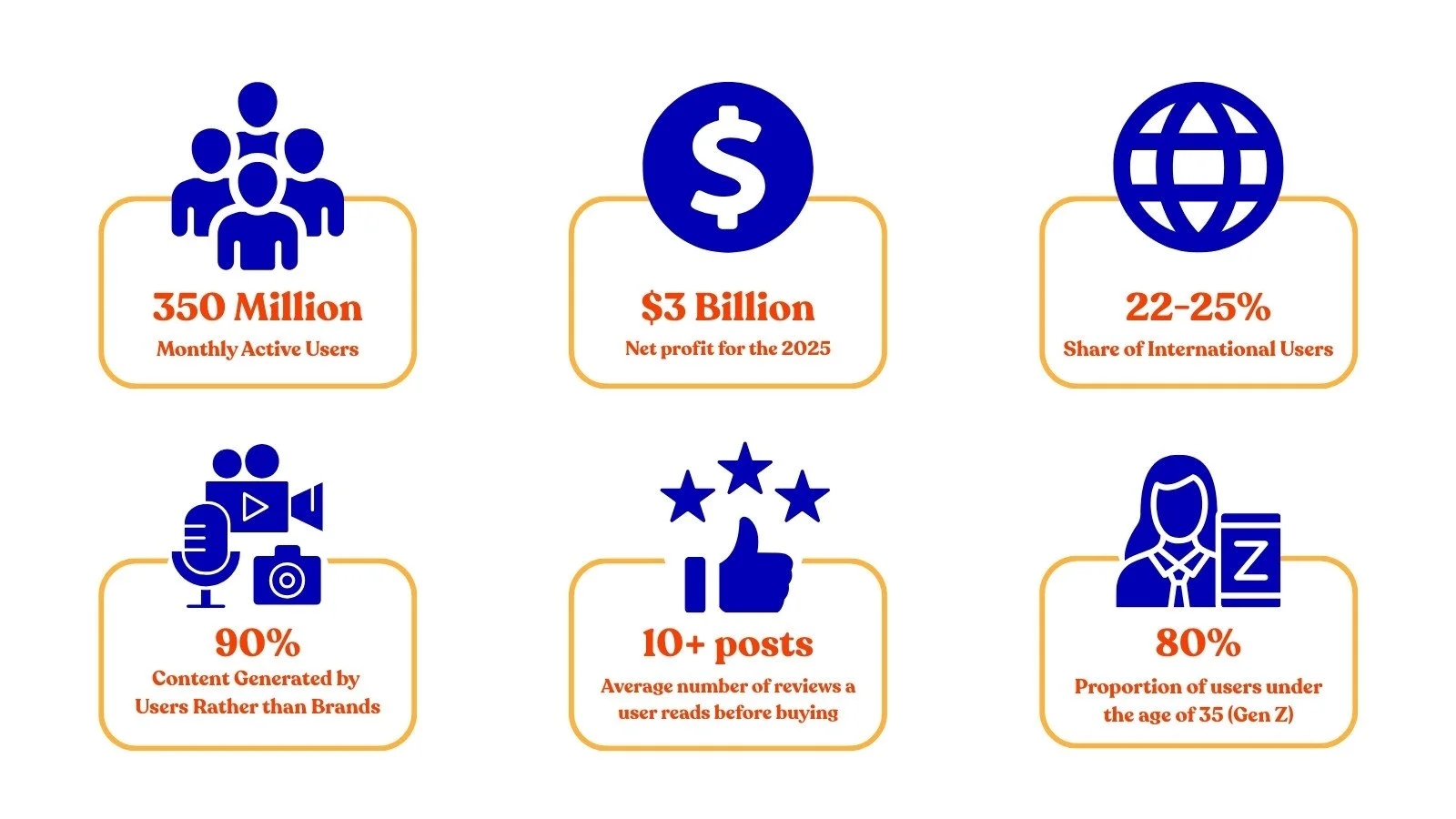
Xiaohongshu in Numbers, 2025
Today, RedNote is less “a place to post” and more “a place to decide.” It has grown into a massive ecosystem of 300+ million users, evolving from shopping lists into a comprehensive lifestyle manual that influences everything from beauty and fashion to education, wellness, and global travel. The platform’s core audience is overwhelmingly young, affluent, and female, with over 70% of users falling into this category, mostly Gen Z and Millennials in China’s Tier 1 and Tier 2 cities. RED’s audience doesn’t treat content there as a mere entertainment. They treat it as input for real-life choices.
For a Western observer, the closest comparison is not one platform but a blend. RedNote borrows Instagram’s visual polish, Pinterest’s “save and organize” behavior, and the trust dynamic of review culture—think Amazon reviews or the best kind of Reddit thread. But it runs on a different energy. People don’t just scroll. They search. They save. They return. They use the app like a lifestyle search engine, and that changes everything.
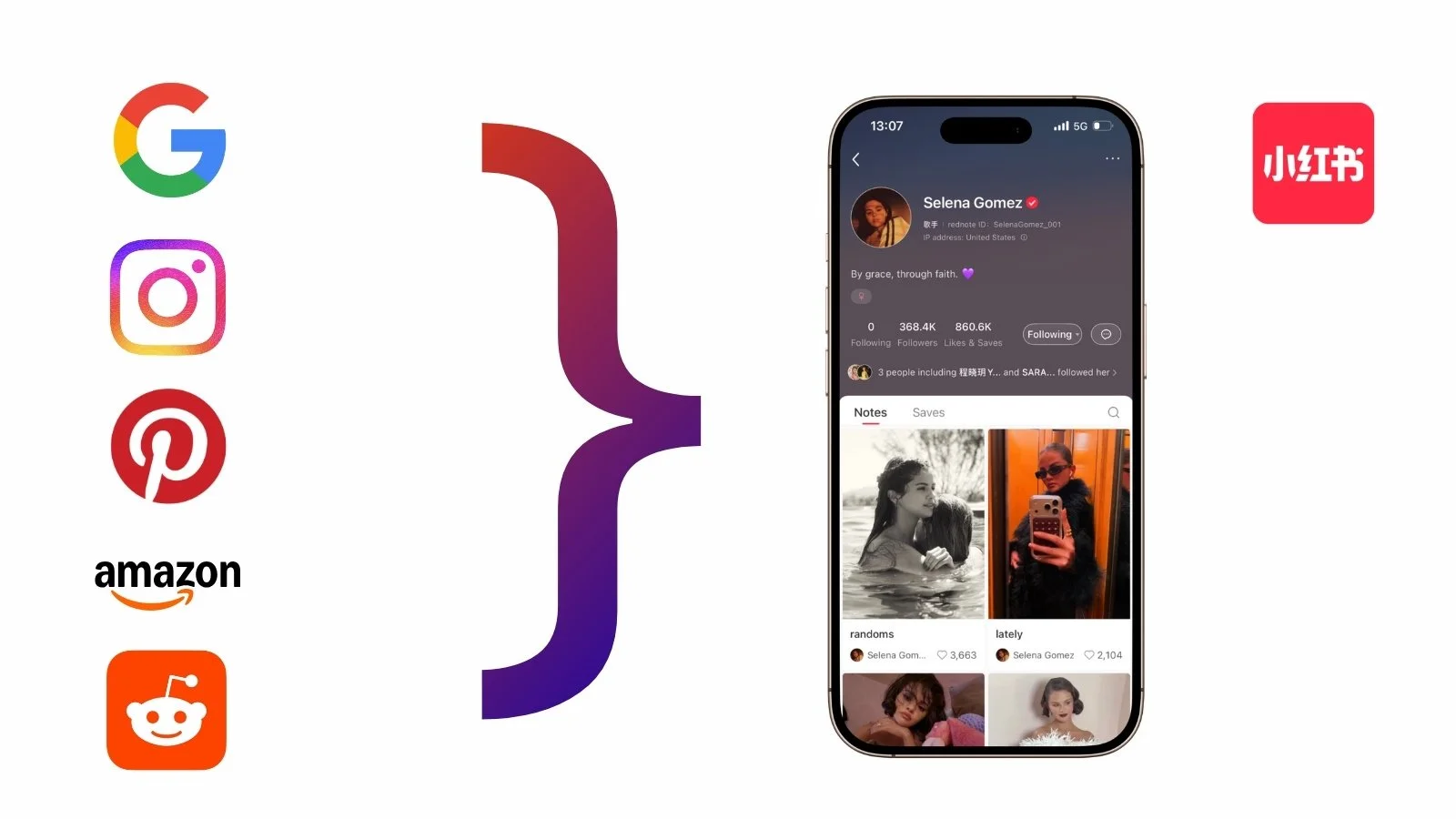
Xiaohongshu in relations with Western Social Media Platforms
"Planting Grass": Why Authenticity Wins on RedNote
The magic of Xiaohongshu is captured in a phrase you’ll hear again and again: “Planting Grass” (种草). It describes the moment desire is planted through authentic content. The most common scenario is that someone shares a product, a routine, a place, a trick, a result… and suddenly the viewers want it too. Not because of an ad. But because it vetted by people who seem like you, or like who you want to become. That subtle social proof is the platform’s main currency, and Chinese brands have learned to work with it instead of against it.
This is where RedNote becomes really effective. Brands use it to seed demand early, before a consumer is ready to buy, by shaping the research phase: comparisons, first impressions, “what I wish I knew,” “best options under X,” “pros and cons,” “real results.” When this works, it doesn’t feel like marketing. It feels like help. Short sentence. Big difference.

Xiaohongshu Influencers Pyramid
In order to make collaboration between influencers (KOLs in China — key opinion leaders) influencers and brands more transparent and efficient, RED introduced a whole platform dedicated to forging brand deals.
“Pugongying” (蒲公英), meaning “dandelion” is RED’s one of the most distinctive mechanisms. Just like dandelion seeds spreading naturally, the system is designed to help content travel organically through trusted creators. Pugongying is RED’s official creator marketplace, connecting brands with influencers and everyday users for sponsored collaborations. It allows brands to search for creators based on audience profile, category, and engagement quality, adding structure and transparency to influencer campaigns. At the same time, it keeps the focus on credibility and content fit, which is essential on a platform where trust drives results.
Why the Instagram Strategy Fails in China?
For years, RedNote had a simple problem: people would see a product on the app, get excited about it, read reviews and comparisons — and then leave the app to buy it somewhere else. The inspiration happened on RedNote, but the money was spent elsewhere. Imagine seeing a great lipstick on Instagram but having to go to the external shop to buy it.
That “walled garden” behavior was inconvenient for users and frustrating for brands. In 2025, the game shifted. Integrations like the “Red Cat Plan” with Tmall and the “Red-JD Plan” with JD.com started to close the loop, creating a more seamless “Planting-to-Pulling” cycle, discovery to purchase without breaking the social flow. That doesn’t just change conversion. It changes strategy, because it makes the journey more trackable and the funnel less leaky.

TMALL Ambassador, Ho Minghao
For Western brands, the big lesson is simple and uncomfortable: RedNote is not a place where you can just translate your Instagram playbook and call it localization. The winning brands don’t treat the platform like a billboard. They treat it like a culture engine. They show up with content that earns trust, not content that demands attention. They learn the community language, they respect the platform’s taste, and they invest in formats that match high-intent behavior, that means searchable, save-worthy, comparison-friendly.
This is also why roles like KOCs (authentic consumer voices) and KOS (sales professionals acting as human, knowledgeable storytellers) matter so much.
The Future of Social Commerce, Already Here
RedNote is moving toward a future where commerce feels less like “selling” and more like “guiding.” One of the clearest examples is the rise of Quiet Selling - calm, sophisticated, educational livestreams that feel closer to a masterclass than a hard pitch. It’s the opposite of loud, high-pressure tactics. It’s much slower, and softer compared to classic live-streaming sessions on the Chinese internet. Interestingly, it often proves to be far more persuasive.
At the same time, the platform is becoming a powerful laboratory for aesthetic and cultural fusion. Western trends like “Britishcore,” “Quiet Luxury,” or other global style waves get localized quickly, reshaped through the lens of Chinese taste and community dynamics. In parallel, there’s growing interest in Feiyi, Chinese’s traditional crafts and cultural heritage, reframed as modern status, identity, and taste. The result is a feed where heritage and modernity aren’t competing. They’re collaborating.

Feiyi (非遗) Chinese Cultural Heritage in a Contemporary Form
And then there’s the bigger meta-shift: RedNote is increasingly acting as a default lifestyle search engine. People aren’t just discovering new brands; they’re outsourcing decisions to a community they trust. In an era where Western users are growing tired of AI-noise and over-optimized content, RedNote’s “human-curated proof” model feels less like a China-specific phenomenon and more like a glimpse of what’s coming next, everywhere.
Win the Research Moment on RedNote
RedNote’s story is compelling because it’s not just about growth. It’s about evolution. A simple recommendation guide became a community, a community became a platform, and a platform became a lifestyle bible. The reason it works is almost old-fashioned: people trust people.
For brands, especially Western ones, the opportunity is real—but the entry ticket isn’t “more content.” It’s better content. More useful. More culturally fluent. More worth saving. If you can win the research moment, you can win the purchase moment too. And on RedNote, those two moments are now closer than ever.
