
Why WeChat Is Non-Negotiable for B2B Brands in China
Many international brands enter China assuming that digital strategy works the same way as elsewhere — just at a different scale. What they quickly discover is that China operates on a fundamentally different logic.
WeChat (known as Weixin 微信 in China) is not just a messaging app. It is the operating system of daily professional life in China. The channels you rely on everywhere else — Google, Facebook, LinkedIn, Instagram, YouTube — are blocked or barely used inside China. Your Chinese partners, potential clients, and industry contacts live on WeChat instead. Without a verified Official Account, your brand does not exist to them.

For B2B brands specifically, WeChat serves as your primary digital touchpoint: a verified brand page, content marketing hub, lead generation tool, and CRM channel — all in one.
The Closed Loop Reality: In 2026, WeChat is a self-contained ecosystem. Users research, communicate, transact, and follow brands — all without leaving the app. B2B brands that are not inside this loop are effectively invisible to Chinese decision-makers.
What WeChat Replaces in Your Existing Stack
For international brands, a WeChat Official Account replaces or supplements: your company website (for Chinese audiences), LinkedIn company page, email newsletters, and CRM broadcast tools. It is not an addition to your strategy — it is your China strategy.
Choosing the Right Account Type
WeChat offers two types of Official Accounts for businesses: Service and Subscription. They differ in posting frequency, feed visibility, and access to tools like WeChat Pay, Mini Programs, and CRM messaging.
Here's the part that catches most foreign brands off guard: you cannot switch types after registration. Pick wrong, and you either live with the limitation or start over from scratch — losing your followers, history, and verification in the process.
A common shortcut, and why it backfires: Some newcomers ask a Chinese colleague or partner to open a personal WeChat account to get started quickly. It feels faster — but you won't legally own the account, and it was never built for business communication at scale.
Which account type fits your business depends on how you plan to use WeChat — content publishing, lead capture, customer service, or all three. We walk through exactly how to make that call, plus the full registration path, in the playbook below.
How to Register as a Foreign Company
Contrary to popular belief, you do not need a Chinese business entity or Chinese ID to register a WeChat Official Account. If you have a legally registered business outside of China, you can register a Service Account using your overseas business license — and the account will be fully visible to users in China, same as any domestic account.
Plan for lead time: Verification typically takes several weeks, and there are two different registration paths depending on whether you're registering as an overseas company or through a Chinese entity (WFOE) — each with its own document requirements and, in the WFOE case, an admin-identity requirement that catches many foreign brands off guard late in the process.
Getting this step wrong — wrong account type, wrong documents, wrong admin setup — means starting over. The playbook walks through both registration paths, the exact documents WeChat expects, and the verification pitfalls that trip up foreign applicants most often.
Do it yourself, correctly, the first time: WeChat Registration: The Foreign Brand Playbook — $49, instead of the 1,500–3,000 USD agencies typically charge.
Content Strategy for B2B WeChat Accounts
Content is not optional on WeChat — it's the proof of your brand's ongoing presence and expertise in the Chinese market. An account that goes quiet reads as a brand that's gone quiet too.
What Content Works for B2B
B2B audiences on WeChat follow accounts to learn new things or to solve problems — not to be sold to. The most effective content mix includes:
- Industry insights and trends relevant to your sector
- How-to guides and practical explainers
- Company news and product launches, framed as educational content
- Case studies from the Chinese market
Content built around specific moments in the buyer relationship — like preparing for a trade show — tends to outperform generic company updates.
Posting cadence: Service Accounts are limited to 4 posts per month. Use this constraint as a quality filter. Each post should deliver genuine value. Accounts that haven't posted in over a month often still receive steady traffic from users exploring their menu tabs — so your setup matters beyond just articles.
The Menu Tab: Your Always-On Sales Tool
Many brands overlook the menu tab — a persistent navigation bar at the bottom of your account page. For B2B brands, this is prime real estate: link to your product catalogue, contact form, case studies, or a Mini Program for enquiries and demo bookings that syncs straight into your CRM. Users visit accounts specifically to find contact information and quick links — make it easy for them.
Authenticity Over Automation
AI tools can accelerate content production, but Chinese readers can tell when the tone doesn't match or sentences feel robotic. Small and mid-sized B2B brands often win because of their human touch. Use AI as a helper, not a replacement — especially when writing for a culturally distinct audience.

"Small and mid-sized B2B brands often win on WeChat because of their human touch — that's not something you want to automate away." — Miriam Dabrowa, Founder, Digital Hotpot
How Buyers Find You on WeChat Search
Chinese B2B buyers don't Google your company — they search inside WeChat itself, using its built-in search function (搜一搜). Someone who scanned your QR code at a trade show, or heard your name from a colleague, will type it into WeChat's search bar before they type it into a browser. If your account and articles aren't set up for that, you're invisible at exactly the moment someone is looking for you.
Same discipline, different engine: Getting found on WeChat Search takes the same discipline as SEO anywhere else — it's just a different search engine, with different rules.
WeChat as a Trade Show Marketing Tool
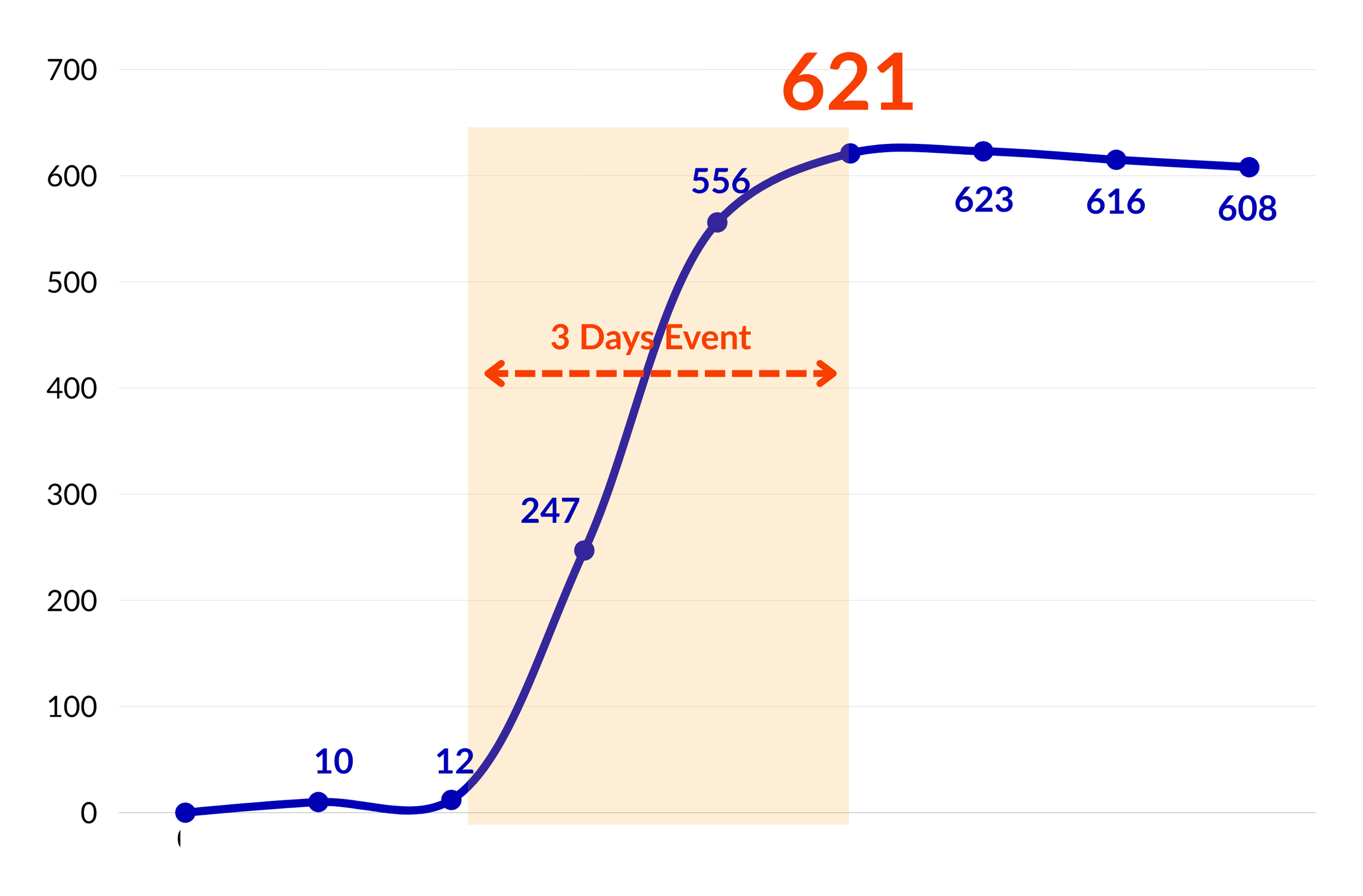
Trade shows are one of the clearest places where the gap between Western and Chinese B2B marketing shows up. Watch the floor at any Chinese trade show: visitors don't collect business cards to follow up by email later — they scan a QR code on the spot. If there's nothing to scan, the connection is gone the moment they walk away.
A verified WeChat Official Account turns booth traffic into a warm, retargetable audience — before, during, and after the event. Foreign brands that show up to a Chinese trade show without one are, in practice, invisible to a large share of the buyers walking the floor.
What Changes On-Site
Western trade show habits — badge scans, printed brochures, a follow-up email a week later — don't map onto how Chinese buyers actually behave. QR codes replace business cards. WeChat articles replace landing pages. And the response window shrinks from days to hours: by the time a follow-up email lands, a Chinese competitor may have already exchanged three WeChat messages and booked a factory visit.
We've written a full breakdown of this shift, including why brochures, badge scans, and email follow-up quietly stop working the moment you land in China: Why Your Trade Show Playbook Breaks in China.
Exhibiting soon? Get our free short guide — Why Your Trade Show Playbook Breaks in China — covering the exact QR, content, and follow-up setup to have in place before you land.
6 Common Mistakes Foreign B2B Brands Make
One wrong move during registration or early strategy can cost time, money, and credibility. These are the mistakes we see most often.
The fix for each one — including exactly what to do instead — is in WeChat Registration: The Foreign Brand Playbook.
Ready to Start on WeChat?
Ready to register your own account? Get the complete step-by-step playbook — $49.